History of games – Dominoes

Dominoes is an ancient tile-matching game that almost certainly began in China during the Song dynasty, around the 12th century, before spreading west through Italy in the 1700s and on across the rest of Europe. The little black-and-white tiles you tip out onto the kitchen table today are the descendants of a game that has kept families company for the best part of a thousand years. Below you will find where it came from, how it travelled, what the pieces were once carved from, how to play in five short steps, and why it still earns its place in the toy cupboard.
This is part of our series on the games families have loved for generations. If you enjoy this, you might also like the story of Fox and Geese, one of Britain's oldest hunt games, and our wider look at the history of wooden toys in Britain. And if you would rather learn some rules first, our step-by-step guides to quoits and draughts walk you through scoring and strategy.

A game that crosses the generations
Almost anyone can play dominoes, whatever their age. It is one of the few games where a five-year-old and a grandparent can sit at the same table and play on genuinely fair terms. The rules are simple enough to pick up in a single round, yet the game leaves plenty of room for cunning once everyone knows what they are doing.
That mix of simplicity and depth is exactly why dominoes has lasted. It needs no batteries, no screen and no instructions longer than a postcard. For families looking to spend an evening away from devices, it sits comfortably alongside our other screen-free favourites and games of similar vintage, kept in the same board games collection as draughts and backgammon. If the appeal of a game with no screen attached rings true, the evidence hub at The AntiScreen Movement is worth a read.
Where dominoes came from
The trail leads back to China. The Oxford English Dictionary and most game historians trace the tiles to the Song dynasty, with written references appearing around the 12th century. Chinese dominoes were designed to represent every possible throw of two dice, which is why a traditional Chinese set runs to 32 tiles rather than the 28 in a Western double-six set. You can read a fuller account of the game's roots in the overview of dominoes on Wikipedia and the word's own history in the Merriam-Webster entry for domino.
The word itself has a charming history. "Domino" once meant a hooded winter cloak worn by priests, black on the outside and white within, and that black-and-white contrast is widely thought to have lent its name to the tiles. The tradition of recording games and pastimes is a long one in Britain, and collections held at institutions such as the British Library and the Victoria and Albert Museum show just how far back our affection for simple table games reaches. For a wider view of the games preserved and studied in this country, the Traditional Games archive is a lovely thing to lose an afternoon in.
Early tiles were made from bone, wood or ivory, the materials most readily to hand. The bone-and-ebony pieces gave the game its enduring nickname: dominoes are still affectionately called "bones". By the 1700s the game had taken hold in Italy, where it became a fixture in family homes and coffee houses, before travelling north into France, Britain and beyond. By the Victorian era it was a settled part of the British parlour, sitting alongside the other table games we still play today. It arrived in good company. Jaques of London, founded in 1795 and the world's oldest games company, was already at work bringing games such as Ludo, Snakes and Ladders and Happy Families to British homes, and in 1849 created the Staunton chess set, registered by Nathaniel Cooke, who worked alongside Jaques on its now-famous design.
The journey of dominoes, in brief

How to play dominoes, in five simple steps
If you have never sat down to a game, here is the shape of a standard double-six game for two to four players. It takes about a minute to learn.
Place all 28 tiles face down and shuffle them. This pile is the "boneyard".
Each player draws a hand: seven tiles for two players, five each for three or four. Keep them hidden.
The player holding the highest double lays it down to start the line. If no one holds a double, the highest tile starts.
Take turns matching a tile end to an open end of the line. A three must touch a three, a five a five, and so on. If you cannot go, draw from the boneyard, or pass if it is empty.
The first player to lay all their tiles wins, or if the game blocks, the player with the fewest pips left in hand. Add up the losers' pips to score.
That is the whole game in miniature. Once everyone has the hang of the matching, the skill comes in holding back useful tiles and forcing opponents to draw a tile they cannot use. A double-six set is the usual starting point for a family; larger double-nine and double-twelve sets bring more tiles and longer games once children are confident. If you enjoy games with a similar quiet strategy, our guides to draughts and croquet for beginners are cut from the same cloth.
A few ways to play once you have the basics
The block game above is the friendliest starting point, but the same box of tiles opens up a handful of gentle variations once children are confident. It is worth knowing the names so you can suit the game to the moment.
Draw dominoes. Almost identical to the block game, except that when you cannot go, you keep drawing from the boneyard until you can, or until it is empty. It slows the game down kindly and gives younger players more chances.
Fives (Muggins). You score whenever the open ends of the line add up to a multiple of five. It brings a little more arithmetic in, and rewards children who are starting to enjoy adding in their heads.
All Fives with a spinner. Doubles are laid crossways so the line can branch, which makes the counting a touch trickier and the table livelier.
None of these needs anything beyond a standard double-six set, so you can move between them as the mood, and the ages around the table, change.
Quietly good for little ones
There is a reason teachers reach for dominoes in the early years. The whole game turns on matching numbers, which means children are counting, comparing and adding without ever feeling that they are doing sums. That kind of playful, hands-on number work is exactly what early-years specialists encourage; the principles set out by Early Education and the government's Early Years Foundation Stage framework place real value on learning through play. The National Association for the Education of Young Children makes much the same case: children learn best when the learning is wrapped inside something they want to do anyway.
Along the way, children practise counting, matching, sorting and simple addition, and they learn to think a move or two ahead. Picking up and placing the tiles is good for small hands too, building the fine-motor control that later helps with holding a pencil. A picture set such as our animal dominoes works beautifully for the very youngest, who can match pictures before they are ready for pips. If you like games that teach without trying too hard, our round-ups of educational wooden toys and Montessori toys are good places to browse. For younger children still, an abacus or a set of building blocks works in much the same counting-through-play spirit. Our guide to learning toys for four year olds gathers a few more ideas along the same lines.
Dominoes as spectacle
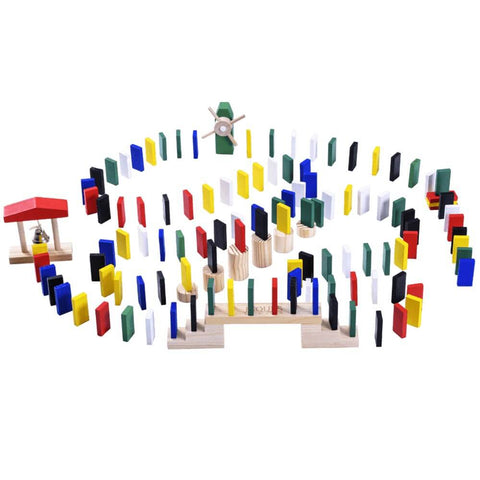
Somewhere along the way, people stopped playing dominoes and started toppling them. The domino rally, where tiles are stood on end and knocked down in a cascade, has become a hobby in its own right, and successive attempts at the largest single-push chain have drawn enormous crowds and television cameras. It is a fine way to show children cause and effect, patience and the satisfaction of a plan coming together, even if the building takes considerably longer than the falling. If your household enjoys that sort of hands-on, no-screen play, our guide to analogue alternatives to screens is in much the same spirit, and there is more on the case for it in our piece on a smartphone-free childhood. For practical ways to make room for it at home, the reading over at The AntiScreen Mov